Wednesday, January 28, 2009

Successes come in pairs

Check out more pictures from this trip and past trips at: http://picasaweb.google.com/kendradey/

Our January trip to Ecuador ended up being as successful as I could have possibly imagined. We finished installing nine rainwater tanks in La Encañada. An example is shown to the left. They consist of a bamboo gutter, a covered 550 liter plastic water tank on a platform, and the necessary hosing and adapters to deliver that water to the bathroom toilet and sink and a kitchen tap. We installed these systems over the course of six days of community work and for under $1,000 total budget.

We made laminated versions of these signs and put them up in every household to remind them how to maintain their rainwater tanks, how to use the secure 8 liter drinking water storage containers we provided, and how to dose each of them with the right amount of chlorine to have 100% safe drinking water.

On the last tuesday before we left, we went to the mayor of the Mera Municipality, which includes both La Encañada and Santa Ana, and presented a report on the work we had done. Basilio later reported that he felt the mayor was floored by the document, and he promised to provide all of the materials should they want to do such an installation in another community. I think he probably will too, since it is such a great deal for him -- give around $1000 worth of supplies (a fraction of the usual tens of thousands of dollar infrastructure projects they deal with) and have a community feel like the mayor has really done something substantial. It's a great deal for us too: the Santa Ana technical team gets all of the expensive supplies paid for, and Sacha Yaku only has to provide a small amount of administrative funds and pay for the time put in by the technical team -- expenses that the municipality is not willing to or able to make.

The technical team in Santa Ana is already getting requests for water quality testing, hygiene and health workshops, and rainwater tank installations. They are working on a proposal right now for a small community that sits in between La Encañada and Santa Ana called Chinchayaku. Although one never can tell with these things, the mayor is in office until April and wants to make communities happy in order to get re-elected, so I think it is quite likely that this project will go through!

And all of that is merely the first of our pair of successes. The other success is in Santa Ana. Not only do they continue to have water all day everyday, but we also manage to close off that pesky channel the water was escaping through in the river intake. What took us weeks during the first summer in Santa Ana (2006), took us three days this time. And it is a good thing it only took three days, because three days was all we had! We literally poured cement on Wednesday, came back to Santa Ana for the traditional 'despedida' or goodbye party, and then left at 6am on Thursday morning. Here are some photos of the operation:

(Hauling rocks and sand through a swamp and up a hill to the river intake. Men and women worked together to carry several cubic meters of material up the hill for this wall.)

(The temporary dam of sticks and plastic we built in order to have a dry place to build a concrete wall)(The construction scene)

(Jesus Moya finishes off the concrete wall)

So Santa Ana has clean drinking water, so does La Encañada, and we hope that it is only a matter of weeks before Chinchayaku does as well. Not bad for one trip.

Clean water for a new community

A short update from the amazon rain forest of Ecuador.(This is the group I am working with - Emily, Nicole, Fatima, Kendra, Dorothy)

We've spent about 5 days now in La Encañada, a new community with just nine families. (The moon rises over La Encañada)

Turns out we'll be able to give them all water systems from the start. There are fewer families, the local government chipped in some money, we got a little extra from the MIT Public Service Center, and suddenly we have enough funds to make it happen!

Its a funny thing – we know were doing our job right when we are essentially superfluous. The team we have put together from Santa Ana is amazingly capable – with everything from leading planning meetings, to selecting the right trees to cut down for platform construction, to teaching basic hygiene to children in the school, to leading a water and health workshop in the whole community. (One of the platforms we've built for the rainwater tanks)

It is a pleasure to sit back and watch them work, mostly speaking to the members of Encañada in their native language Kichwa. They mix in enough spanish words and ive picked up enough Kichwa that I can mostly tell what they are saying. Every once in a while i'll make a suggestion , like why dont we install one tank today so we are sure we know how to do it, and Basilio, or Melida, or Esteban will jump on the idea, start speaking to the others in Kichwa, and they'll act on it.

That's not to say that I have been completely useless – the other day I unclogged a toilet that hadn't worked for two years. The family was pretty elated since they had been just going out in the woods for all this time. Its the little things that count…

I have to confess that the performance of both the Santa Ana team and the 9 families that make up the community of Encañada has exceeded my expectations.

Melida and Esteban did a fantastic job on the hygiene and health workshop, with only a little coaching from me. A bit more work on project management and documentation skills, and a bit of funding, and I think this team could really go into a new community and give clean water.

Tomorrow we have the day off and one of hosts in Encañada is taking us on a hike up to a hill from which we are supposed to be able to see santa ana : )

Monday, January 26, 2009

In Santa Ana once more

I´m back in Santa Ana Ecuador for the fifth time now, this time with four other students and big plans to form a team from Santa Ana that will help other communities implement individual rainwater tanks. It rains so much here that 500 liter tanks are big enough that families have enough water for drinking and cooking almost all the time, and the tanks are around $80 each so it is a pretty reasonable price to provide clean, accessible water (we´ll be running hoses from the tanks with a little faucet on the end which they can put in their kitchens, which are usually separate structures from their houses with thatched roofs and a fireplace to cook on).

On January 6th we leave Santa Ana for one of their neighboring communities, La Encañada to implement five of these systems along with the team we have formed in Santa Ana. Then these families will pay back the cost of the system over a year so that the community can buy 5 more, etc. There are only 15 families in La Encañada, so after 2 years they´ll all have the systems.
As for the community water system in Santa Ana, it has its problems but they are way more minor than they were before. The new operator is this amazing 15 year old boy named Inoc, the son of Melida, one of the most responsible women in Santa Ana, so we are really excited about the community´s choice. (Inoc and Kendra fixing a leak in Santa Ana)

We´ve been working with him over the last 3 days and we´re getting pretty close to fixing up almost all of these little problems -- an amazing improvement over trips past. Slowly but surely Santa Ana is getting a handle on how to operate and maintain this system.

(Inoc standing at the river intake. Notice the semi-crooked wall in the background (the wall we built during the summer of 2006) and the water escaping to the front (where we need to build another such wall)

I love being back here. I love the people, the place, and this crazy water system that we´ve patched together over and over again. Santa Ana feels like a second home by now, but there are always new things to do and learn. It was my first News Years Eve here so I got to see how they build and burn life size dolls as a symbol of forgetting the past, then dance all night long. We made it till 4 am before we went to sleep.

Then last night we went hunting toads by moonlight on the other side of the Pastaza River. The technique is to listen to their calls and track them very quietly, then shine a flashlight on it once you are close enough and grab it with your hand. It was so beautiful under the stars and the moon, wading through shallow pools that form on the bank of the river. I think today we´ll get to eat frog maito (maito is a traditional way of cooking fish or birds or other kinds of meat wrapped up in a bananna leaf and cooked in the fire).

(On our day-trip to La Encañada, we brought a computer donated by TecsChange. These are some photos of its journey -- by horse).
(And by canoe).

Sunday, October 19, 2008

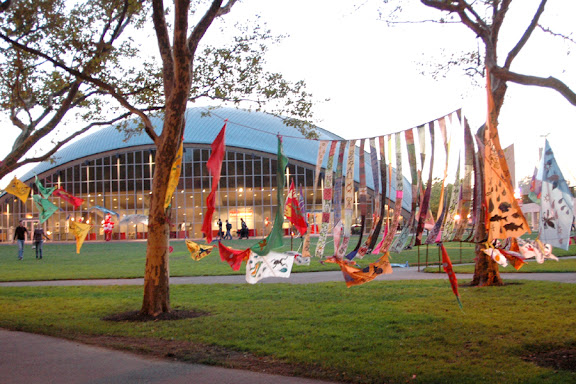
Business as Unusual Art event series

Here are some photos from the first art event in the series we have been organizing as a collaboration between the MIT Western Hemisphere Project, Sustainability@MIT, Global Poverty Initiative, and artist Cindy Snodgrass.

This is the gorgeous outdoor sculpture that goes with the event.

As participants arrived (mostly students, parents, and siblings considering it was Family Weekend at MIT) we had them spin a wheel to find out where they would be re-born according to actual income distributions in the world.

  • 40% of people live on <$2 a day
  • 40% live on $2-10 per day
  • 19% live on $10-$150 per day
  • 1% lives on >$150 per day ($54,750 per year)
Then they get a packet about a family with about that income level somewhere in the world and learn about the food they eat in a week.

With this information, they added to a growing collage featuring a map of how climate change is going to impact agriculture in the world.

Here is one of the resulting hexagons.

Then they started stamping shirts, cloth grocery bags, and fabric pieces with stamps related to food and water. Here are some more photos.

This will later get sewn up into a hand-made grocery bag.

A father looking on as his daughter stamps.

Stamping onto a bag made of the burlap from a coffee sack brought in from Latin America. We have burlap sacks from Costa Rica, Colombia, and Brazil among others.

Sunday, September 21, 2008

Sun Tea at MIT

Well, I'm back at MIT for my last semester here. It's a different sort of semester, first of all because it is my last, and secondly because I'm only taking two (straightforward) technical classes to finish my major, along with the 3 HASS (Humanities Arts and Social Sciences) classes I need to finish out the 8 that MIT requires. They are a lot of fun -- Concensus Building for Sustainable Development, How to Stage a Revolution, and Social Documentaries -- and I feel like I am getting a taste of the liberal arts college experience to have all these reading and discussion based courses and few of the problem sets for which MIT is famous.

Here is 77 Massachusetts Avenue (the main entrance to MIT's infinite corridor), as seen from Froy and Fernando's room. It's not quite the view I had this summer on Pine Ridge, but still, it could be a lot worse.

It's always an adjustment to come back to MIT; it seems so artificial and contrived after being in places where everything is less neat and tidy but so much more real.

Still, life is good. Fernando and I found some nice glass bottles at Goodwill and have been making sun tea in the windowsill. I never realized how little sun we actually get in dorm rooms at MIT, what with all the clouds and buildings and lack of a front or back porch (Froy and Fernando live on the 4th floor), but still, it seems to work pretty well!


For those of you who know my sister Lexie, she has just started her freshman year at Colby College in Maine. And my brother Trav just got married at the end of August. Here's a photo of me with my siblings, father, and grandmother at the wedding.

At the end of August after the wedding, my Dad and I drove out to Maine with Lexie to drop her off at Colby, and then Dad, Froy and I went canoeing in Maine for three days. We had perfect weather and Froy got to see some of the animals of the north woods -- moose, loons, herons, bald eagles. Here are some photos:

Froy and I


A color-enhanced sunset over Lobster Lake (digital cameras these days are something else)


Froy, Dad and I attempting to fit all three of us in a self-shot picture


Dad kayaking past one of the two moose we saw in three days.


Looking forward, something I am excited about it is an art event we are organizing for Family Weekend at MIT about food, climate, poverty. The MIT Global Poverty Initiative are challenging people to try to eat on $2 a day for a week to get a sense of what it is like for the 2.5 billion people in the world with a daily income of $2 a day or less. And unfortunately, Climate Change is going to make it even harder for subsistance farmers in some of the poorest parts of the world (check out this map). The idea is to spread awareness about these issues, and how our lifestyle choices here impact others around the world, through painting and collaging with people who come to the event.

On a final note, my medical school applications are in for the Latin America School of Medicine in Cuba, along with a bunch of US schools. I'll be doing interviews throughout the semester and hopefully wind up with a couple of offers to chose from. Meanwhile, I'm dreaming up ideas for what to do with my 8 months between graduation and September should I not end up starting medical school in Mexico or Cuba...

Friday, August 22, 2008

Back home again

Being back home isn't quite so different as I thought it'd be. For one thing, I'm still cooking with fresh garden vegetables: my mom and I just made some amazing bruschetta with some basil and ripe tomatoes from her garden.


And here we are: my mother/cooking mentor and myself just about to dig into our meal.


For another thing, if I get a toothache I can still harvest some toothache medicine (echinacea, or purple coneflower) since my mom has it planted in her wildflower garden.


And yes I have tried it out, a couple of weeks into my stay at Mike's house near Wounded Knee. Allison and I had gathered a bunch of roots, washed them and dried them, and I was curious exactly how it would numb my mouth if I tried chewing on the root. Mike later told me I probably took about four times as much as I should have, so the result was a bit interesting:

The summer comes to a close

6:00 am this morning I arrived in Madison, Wisconsin. That's pretty much exactly 24 hour after I left Lonesome Valley, with the sun just beginning to rise and bathe the rolling hills in warm yellow light. I knew then just how much I'd miss the place.

My last weeks on Pine Ridge Reservation were quite amazing; things seem to have a way of coming together at the last minute. Literally on my last day at work, Wednesday, Bob and I were able to meet with some of the administrative leadership at Oglala Lakota College and everyone was very supportive of working to get the college lab certified to run water quality tests for the tribal and federal programs on the reservation. Now the lab staff will be able to move forward, hopefully with the help of some chemistry-inclined MIT students in the future. [Photo is of me wearing a random pair of sunglasses we found while inventorying the lab storeroom].

Things also seemed to fall into a good place with the watershed management project. On two separate days I went out and visited Wounded Knee and Porcupine Creeks with a couple of staff members from the Environmental Protection Program -- we took samples, photos, video, and talked about the various natural and human impacts on the creeks, as well as a fair bit about music and life. One thing that the long driving distances are good for is conversation time. Later, we played with maps and video and sound back at the office in Windows Media Maker (first time I learned Windows had a pretty decent equivalent for iMovie on a mac). All in all I felt like I really did help out with the watershed management plan, mostly by contributing some legwork but also with some ideas for how to move forward on such a large undertaking. It was really rewarding to be working collaboratively with people rather than endlessly pounding away on my computer.